

Four Army Cyber Command Soldiers’ contributions to national security have earned them the first awards of a new ARCYBER form of recognition with a peculiar name.
Sgt. Phillip Lorentz, Staff Sgt. Jeremy Jackson and Capt. Zachary Fennell of the Army Cyber Protection Brigade at Fort Eisenhower, and Capt. William K. Born of the 780th Military Intelligence Brigade at Fort Meade, Maryland, is ARCYBER’s first recipient of the Cyber Peculiar Award, or CyPAw.
Authorized by public law in the National Defense Authorization Act for Fiscal Year 2023, CyPAw is a monetary award that recognizes performance by a military member “whose novel actions, invention, technical or policy achievement enables operational outcomes across cyberspace to strengthen national security.
Lorentz, Jackson, and Fennel earned the award for a two-year collaboration that resulted in the creation of Cerebro, a program that enhances defensive cyber operations by streamlining mission planning processes that Army Cyber Protection Team members had been completing manually.
Jackson explained that the program saves the time needed to identify and apply detection methods and provides a space to curate and refine analytics. Cerebro helps cybersecurity professionals plan missions with insight into up-to-date tactics, techniques, and procedures, and has received positive feedback from other organizations within the DoD cyber community of interest.
Fennell said the award proves that the Army values the creative tools and solutions developed by its talented cyber warriors.
“As a cyber capabilities developer, it shows that the Army recognizes and wants to incentivize our efforts to create innovative cyber capabilities for the force, rather than rely solely on private sector vendors,” he said.
Born, a cyberspace capabilities developer was recognized for leading the development and delivery of multiple cyber capabilities that support U.S. Cyber Command’s Cyber National Mission Force and have directly enabled the success of top priority CNMF missions.
Col. Benjamin Sangster, who commanded the 780th at the time the awardees were nominated and announced, said the award is a demonstration of the caliber of the brigade’s Soldiers.
“It is truly a landmark event, recognizing a talented Army officer’s contribution to defending our country,” Sangster said. “Capt. Will Born is an outstanding example of our cyberspace capability developers, a highly talented team of world-class technicians who could easily work for the industry. Instead, they have volunteered to serve our country, defending our way of life.”
When asked what he might say to other Soldiers to inspire them to take on similar projects, Born said, “Opportunity for operational impact is abundant in the Cyber Mission Force, but the most fruitful avenues are not always apparent at first. With persistence, relationship building, and a commitment to maximizing contributions as a team, success will follow.”
━━━━━━━━━━━━━━━
ABOUT U.S. ARMY CYBER COMMAND
U.S. Army Cyber Command integrates and conducts cyberspace operations, electromagnetic warfare, and information operations, ensuring decision dominance and freedom of action for friendly forces in and through the cyber domain and the information dimension while denying the same to our adversaries.
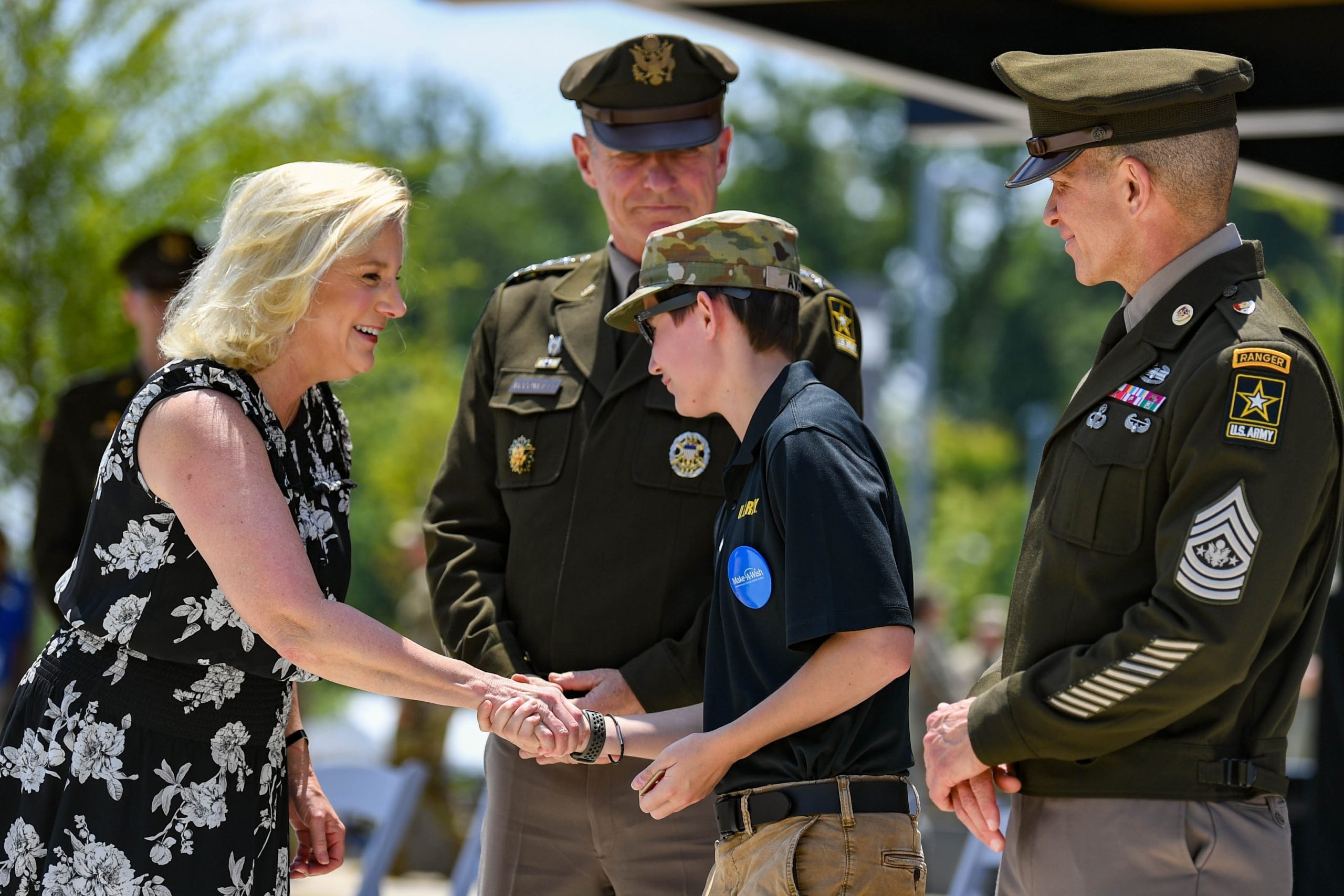
Secretary of the Army Christine Wormuth swore in Ronald “Ron” Shindel, Jeffrey Hamel, and G. Thomas “Tom” Greco as Civilian Aides to the Secretary of the Army during an investiture ceremony at the Pentagon on May 7, 2024.
“Our CASAs play a critical role in maintaining the Army’s relationships with communities across the nation. From assisting with recruiting efforts to helping our veterans reintegrate into civilian life, CASAs keep our all-volunteer force connected to the country they defend,” said Wormuth. “Tom, Jeff, and Ron are tremendous leaders in their communities, and I am confident that as CASAs, they will be outstanding advocates for the Army.”
Ronald “Ron” Shindel, from Merrick, New York, is a retired New York police officer who served as commanding officer of Operation Ground Zero after the terrorist attack on September 11, 2001. He is currently a police chief with the Port Authority of New York and the New Jersey Police Department and is the executive officer for all New York area airports and seaports Shindel was a senior vice president at the American Stock Exchange and a managing director of chief security officer at two large real estate firms. Shindel currently serves as the chairman of military affairs at the Union League Club, as a member of the advisory board of the College of Liberal Arts and Sciences at his alma mater, Hofstra University, and as a board director at the Catholic Health System of Long Island. Shindel earned a BA at Hofstra University, attended the U.S. Army War College National Security Seminar, and holds executive leadership certificates from Texas A&M, Georgetown University, and the Wharton School – Aresty Institute for Executive Education at the University of Pennsylvania.
“There is no greater honor than to be chosen to serve this nation, its Soldiers, and their military families and I look forward to doing so with special enthusiasm and vigor,” said Shindel. “New York is military-friendly, with strong connections to West Point, Fort Hamilton, the Fighting Sixty-Ninth, the Harlem Hellfighters, and it’s the home of the largest Veterans Day Parade and a heralded Fleet Week. My connection to the military started at birth—my dad was a Marine and I was born at a Navy hospital. When it came to my turn to serve, I enlisted in the Air National Guard and I served in a full-time position in uniform. For the past six years, I’ve been an honorary member of the Army’s 160th Special Operations Aviation Regiment, and it has been a special honor to be adopted by that elite unit.”
Jeffrey Hamel, from Los Altos, California, is currently managing director of home and health partnerships at Google, where he is responsible for delivering hardware and services revenue for Google Nest and Google Fitbit brands across retail and enterprise partners. Hamel also serves as co-leader of Google’s Veterans Employee Resource Group, VetNet, an internal community of military veterans, service members, and civilian allies dedicated to unifying, connecting, and serving the military community. His commitment extends to supporting programs like Skillbridge/Hiring our Heroes across Google. Hamel earned his B.S., a U.S. Coast Guard Merchant Marine license, and his commission in the U.S. Naval Reserve while attending Massachusetts Maritime Academy. In addition, Mr. Hamel holds an MBA from Santa Clara University.
“It’s an incredible honor to have been selected by Secretary Wormuth to strengthen the partnership between the Army and the Silicon Valley community,” said Hamel. “The greater Santa Clara Valley, with its rich history in collaboration with the Department of Defense, stands as a unique asset in advancing the Army’s 21st-century priorities, including recruiting, technology readiness and modernization. I look forward to being able to help advance the Army’s connections and commitment to California and Silicon Valley.”
G. Thomas “Tom” Greco, from Star, Idaho, served more than 24 years as an infantry officer. He led an air assault task force deep behind enemy lines during Operation Desert Storm and was decorated for valor and heroism. After retirement as a colonel, he served as dean of students at Treasure Valley Community College, Ontario, Oregon; area chair for the School of Business, University of Phoenix; and chief operations officer for Central Christian College, McPherson, Kansas. His previous leadership roles and responsibilities include chairman of the U.S. Board for Youth Unlimited Gospel Outreach; board chairman of the River Conference of the Free Methodist Church; trustee of Seattle Pacific University; regent of George Fox Evangelical Seminary; and founding member of the Cascade Food Pantry. Mr. Greco served on teams that built over 40 homes for needy families in the U.S. and Mexico. He led and coordinated volunteer disaster relief operations for victims of Hurricane Katrina.
“After a 24-year career in the United States Army and service in college and university leadership and Christian ministry positions, it’s an honor to serve Secretary Wormuth as a civilian aide for the Great State of Idaho,” said Greco. “I look forward to telling the Army story in my state for the growth and well-being of our warfighters, military families, and heroic veterans’ transition into civilian life. I plan to assist our local recruiters in attracting and recruiting the next generation of Army Soldiers and leaders.”
CASAs promote good relations between the Army and the public, advise the secretary about regional issues, support the total Army workforce, and assist with recruiting and helping Soldiers as they transition out of the military.
Each state, the District of Columbia, and the five U.S. territories have one or more CASAs to provide a vital link between the Army and the communities they serve. CASAs are usually business or civic leaders who possess a keen interest in the welfare of the Army and their communities.
Joining the Army is tough; you’re immediately off to basic and individual training, facing drill sergeants and learning the basics of soldiering. Going straight to Ranger School after that? That’s an entirely new level of challenge and excellence.
No Michigan Army National Guard Soldier accomplished all three schools through the Ranger Team Leader Initiative program — until now. On June 21, 2024, 19-year-old Pfc. Chase Cammenga achieved this milestone, graduating from all three rigorous training programs.
The RTLI is a specialized training program for enlisted Soldiers in the Army National Guard who aspire to attend Ranger School. This program transitions Soldiers from initial training to the Ranger Training Assessment Course and then directly to Ranger School. The program scouts for top National Guard Soldiers, selecting those with the highest potential to succeed in the challenging Ranger course.
When Cammenga enlisted in the National Guard two years ago in November while still in high school, his ambition to pursue advanced military training was a driving force behind his decision.
“I wanted to challenge myself and be in the best fighting force on the planet,” he said.
Cammenga was initially set on an active-duty route until a friend introduced him to the National Guard. He discovered the Guard offered a balance between military service and pursuing higher education, with educational benefits such as tuition assistance and the GI Bill.
“One of my buddies joined, and I figured this was a good way for me to do both. I could be in the National Guard and still serve while I’m going to college,” he said.
Cammenga embarked on his initial training. The fear of the unknown was daunting, and his One Station Unit Training experience was no exception. OSUT consolidates Basic Combat Training and Advanced Individual Training at one location.
“It was hard because it was the first time I was away from my family for that long. The training was different from anything I’d ever done before,” he recalled.
Cammenga’s determination to excel in training was driven by a desire to be a member of a team. He chose the infantry military occupational specialty of 11B, or infantryman.
“I’ve always wanted to be the best, but more than that, I want to be able to help those around me,” he said. This mindset was particularly evident during Ranger School.
As his time at OSUT ended, he was identified as a standout candidate based on factors such as his ACFT score of 584 out of 600 points. He earned a spot in the RTLI program.
“I was pretty excited,” he said. “Going to Ranger School wasn’t always a dream, but once I heard more about it, I knew it was what I wanted to do.”
Cammenga’s journey to earning the Ranger tab began with rigorous RTAC training. The 30-day course prepares enlisted Guard members for the Army National Guard “pre-Ranger” course, called the Ranger Training Assessment Course. RTAC lasts 17 days, and all Army National Guard members must complete it before heading to Ranger School.
“In RTAC, the training was incredibly tough. It made us think, ‘If this is hard, just imagine what Ranger School will be like.’ But we always supported each other and lifted each other up,” said Cammenga.
Once RTAC was completed, Cammenga was ready for Ranger School. For more than two months, Ranger students train to exhaustion, pushing the limits of their minds and bodies.
Reflecting on his journey, Cammenga emphasizes the importance of camaraderie and support. “You don’t get your tab; your buddies get it for you. I learned that I had to lean on those around me.”
Recycling during training is a common challenge; for Cammenga, it was no different. Darby, the first phase of Ranger School, was a hyper-structured environment where attention to detail was paramount.
“The instructors were different, with different criteria. It was all about doing everything by the book,” said Cammenga.
Feeling that sinking sensation in his stomach when he realized he had to do Darby again was tough, but he kept telling himself he wasn’t a quitter.
“I felt like I couldn’t go on, but I learned to dig deep and find that inner strength,” he said.
With dedication and hard work, Cammenga passed Darby and moved to the next phase. For Cammenga, the training presented significant challenges, especially the lack of sleep and food for more than 62 days.
“The lack of sleep was the most difficult part for me,” said Cammenga. “There were times I found myself falling asleep while walking. On average, we got about an hour to an hour and a half of sleep a night.” Despite these hardships, he stayed motivated by reminding himself, “At least I’m not in Darby. I can get this done.”
During Ranger School, one mentor, a fellow Soldier in his platoon, had a profound impact on Cammenga.
“He told me that people here will do anything for you; you just have to ask,“ Cammenga said. “His words inspired me to be more patient and to help others wherever I could.“
Cammenga pushed through 12-mile rucks, completed water survival training, navigated difficult terrain, and led battle drills.
“Failure was not an option. I pushed myself harder than I ever thought possible,” he said.
His perseverance paid off when he completed Ranger School and earned the coveted Ranger tab.
“It was one of the proudest moments of my life. All the hard work and sacrifices had finally paid off,” he said.
After Ranger School, he attended airborne school. The training further honed his skills and prepared him for future missions.
“My parents always encouraged me to follow my dreams and never give up,” he said. “During training, they wrote me letters and offered incredible support. Their encouragement was a big part of what kept me going.
When large-scale emergencies occur, a multitude of governmental and nongovernmental organizations at the local, state and federal level respond to assist victims.
Each entity collects and analyzes disaster-related information to plan and execute their emergency response efforts. For U.S. Army Corps of Engineers commanders and first responders, the value of information far exceeds the size of the petabytes of server space on which they’re stored.
USACE cartographers and geographers who work with geographic information systems meet information demand by compiling data and converting it into a visual product that provides insight for decision-making. Using a platform called USACE Common Operating Picture, or uCOP, they collect information from various sources and import or reference it to develop a visualization.
“uCOP is the delivery platform for GIS visualizations and reporting for FEMA response mission assignments including each [mission assignment] identified for Maui recovery,” said Nate Eskridge, a geographer and cartographer from the USACE Sacramento District who is serving as a GIS subject matter expert for the debris planning and response team assisting with the Hawai’i wildfires. “Whether it’s temporary power, infrastructure assessment, or debris removal, GIS technology helps decision makers make better decisions more quickly. We’re able to distill large amounts of data into actionable information.”
For commanders, the value of actionable information is immense as they frequently receive requests for information from the Department of Defense, the Federal Emergency Management Agency, local governments, the public, and Congressional delegations.
“A picture is indeed worth a thousand words, and when you have GIS specialists, as we do in the Corps helping us out, it’s very easy to communicate internally to the Corps of Engineers, externally to FEMA, DOD, the public, and the Congressional delegations, and they make the job much easier,” said Lt. Col. Ryan Pevey, USACE Honolulu District commander. “Our GIS professionals in the corps are top-notch. They have to learn almost every aspect of the mission. They are critical to the success of a mission because they can gather data from other agencies, build bridges, and create that common operating picture so that commanders can make decisions for everything that’s happening on the ground.”
In grade school, children learn a noun is a person, place, or thing. In GIS, professionals connect that person or thing to a place. GIS connects the who, what and sometimes when to the where, and the result may answer the why.
“GIS is taking non-spatially referenced information and making it spatial,” said Jennifer Kist, a GIS subject matter expert from the USACE Charleston District. Kist has been on Maui working with the Honolulu District’s temporary emergency power team and GIS professionals at the Honolulu District since Aug. 14. During that time, she has developed and refined products to gather data and track information about the FEMA generators the power team manages during temporary emergency power missions.
Honolulu District GIS Subject Matter Experts Sarah Falzarano and Elizabeth Ryan stood up the common operating picture for this event and Kist, Eskridge, and others have added to it and improved upon it as the response has unfolded. The Honolulu District SMEs leveraged their knowledge of local data sources and relationships with providers such as Maui County and Kist leveraged her knowledge of working on other temporary power missions with FEMA. According to Eskridge, Kist’s initial and current efforts for the temporary power mission, which started first, facilitated future products for the debris mission.
In an information economy, USACE geographers and cartographers meet this information demand, not through buying or selling of goods, but through the sharing of information.
“Kind of the unofficial motto is ‘sharing is caring’ and really, sharing is not just caring to the individual but sharing is caring to the mission and the corps. Sharing is one of the things that makes us more efficient,” said Jacob Rothberger, a senior GIS analyst from the USACE Fort Worth District who is working with Eskridge in support of the debris mission.
When team members conduct data validation or monitor contractor activities, they can enter information about on-the-ground observations using mobile devices. Using an application called Survey123, they can instantly provide important safety and site-related information to the uCOP.
“The whole point of the Survey123 is its technological capability and its ease of use in comparison to the analog alternative,” said Eskridge. “Before Survey123, they’d have to print out forms or use scratch paper and write all this out then they go back to the office and transcribe it. This mitigates all that. It’s all digital and goes straight into the database, goes straight into a visualization.”
According to Rothberger, information sharing has become significantly easier because of platforms like uCOP and applications used to feed it data. Quality assurance representatives only need a mobile device with network connectivity to enter information into the application that is then available to commanders and other team members in real-time.
“There are two problems with the old way of transcribing information from a piece of paper. One, is it takes way more time, so it’s less efficient, and there’s potential for error when you’re transferring that paper into a spreadsheet or whatever was used to record it,” said Rothberger. “That’s why we say using Survey123 is a more efficient and more accurate way of sharing data because we’ve mitigated some of those things that were using up time and causing the potential errors.”
Although technological advances have reduced the time and labor associated with data gathering and sharing, the practice of making non-spatially referenced information spatially to gain understanding and make decisions has been used by USACE engineers and epidemiologists for decades, if not centuries.
USACE employed geographers and cartographers to develop lithographs to identify sites for dams, levees, and other civil works infrastructure in the 20th century.
In 1854, the London physician Jon Snow helped end a cholera epidemic in the London suburb of Soho by using a map with gridlines drawn on it and plotting victims’ residences. He interviewed community members and victims’ families to identify their drinking water source and created a visual representation of the outbreak. Using this geospatial data, he convinced the local council to remove the handle from the Broad Street water pump, which he suspected was the source of the outbreak. His work helped promote germ theory, which was not widely accepted at the time.
As technology advances and information collaboration becomes more prevalent, the possibilities for employing GIS to provide insight are endless. Still, a place remains for the tactile products and tools.
In the case of the debris planning and response team, printed maps are still a valuable tool. Before sending a team out to conduct data validation, Rothberger provided the team with printed maps of the area. According to Eskridge, it was the “old school” thing to do, and it’s a practice that should never go away.
“They had a phone and we provided them a digital map, but we know, because we went out to Maui, that there’s spotty connectivity. So, we printed them so they can have analog maps on hand to navigate as well,” said Eskridge. “That’s part of a geographer, a cartographer’s job is to make sure there’s a backup to digital. That applies to just about every scenario, whether you’re out in the field or you’re back in the recovery field office, there should be maps on the wall in case the electricity goes out.”